
Energon Green Solutions was represented this week at the 11th HAEE Energy Transition Symposium, held at ALBA Graduate Business School, American College Greece, under the theme “Strategic Energy Shifts: Policies and Politics in Transition.”
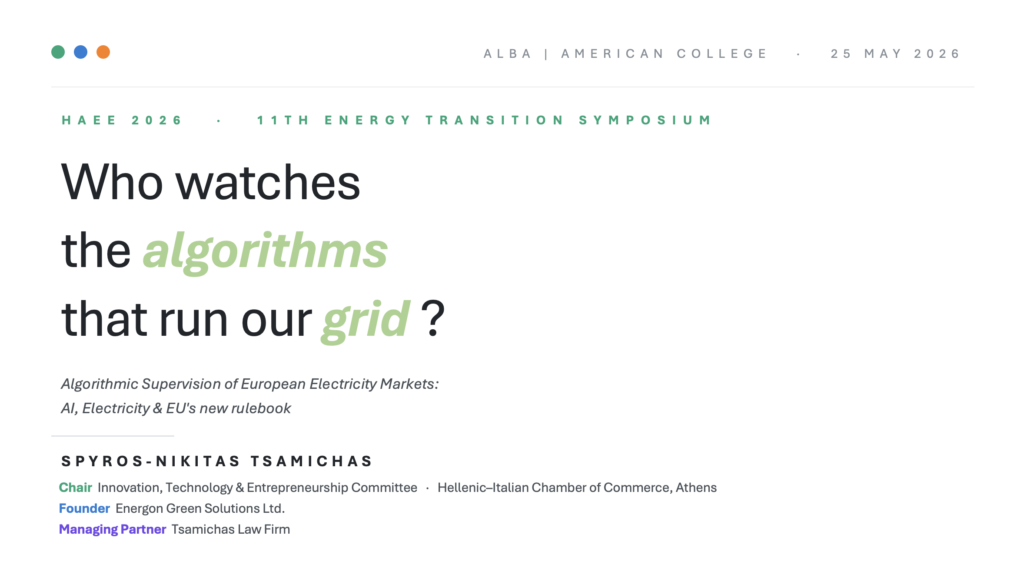
Spyros-Nikitas Tsamichas, presented the research paper “Algorithmic Supervision of European Electricity Markets,” co-developed with the Youth Climate Diplomacy Forum (YCDF), as part of Session III: Governance, Strategic Risk and Emerging Technologies in the Energy Transition.
The Symposium, organised annually by the Hellenic Association for Energy Economics, brings together academics, regulators, industry leaders, and policymakers from across Europe and beyond to debate the strategic direction of the European energy transition. The 2026 edition was hosted across ALBA Graduate Business School and the National Museum of Natural History Goulandris in Kifissia, with academic sessions on May 25 and plenary sessions on May 26–27.
The Paper
The Energon Green Solutions × YCDF paper addresses what its authors describe as the most pressing unresolved question in European energy regulation: how to govern AI systems that now operate the European electricity grid in real time, while four major and partially overlapping pieces of EU legislation impose distinct, sometimes contradictory, compliance obligations on those same systems.
The 3 instruments the EU AI Act (2024), the NIS2 Directive (2022), the Data Act (2023) converge on the algorithms running Europe’s transmission grids, but were drafted by different regulators, on different timelines, and with limited cross-coordination.
At its core sits what the authors call the 200-millisecond paradox: Article 14 of the AI Act requires “meaningful human oversight” of high-risk AI, yet the algorithms balancing the European grid must detect and respond to disturbances within roughly 200 milliseconds — far faster than any human reviewer can meaningfully intervene. The two requirements, the paper argues, are technically irreconcilable under a strict reading of current law.
Drawing on case studies from Terna (Italy), TenneT (Netherlands / Germany), Red Eléctrica (Spain), and IPTO / ADMIE (Greece), and benchmarked against the January 2021 Continental European grid split, the paper proposes an Algorithmic Energy Governance (AEG) framework built on three layers: Classify, Automate, Coordinate.
The accompanying cost modelling indicates that, on current regulatory trajectory, administrative compliance costs across the instrumentsl could double by 2030, and that an automated governance approach could reduce that burden by up to 50%. Counterfactual welfare estimation, calibrated to ACER data, suggests that delayed grid responses at major cross-border interconnectors could account for foregone load-shed value of up to €18 million per event.

Session and Acknowledgements
Session III was chaired by Prof. Kyriaki Kosmidou, Director, Postgraduate Studies in Master in Business Administration (MBA), Aristotle University of Thessaloniki, and Steering Committee member of the HELLENiQ ENERGY Center for Sustainability & Energy @Alba Graduate Business School. The session also featured Dr. Maria Lykidi’s presentation on “The Role of Small Modular Nuclear Reactors in the Energy Transition,” alongside contributions on risk management in the energy transition and waste heat recovery in naval applications.