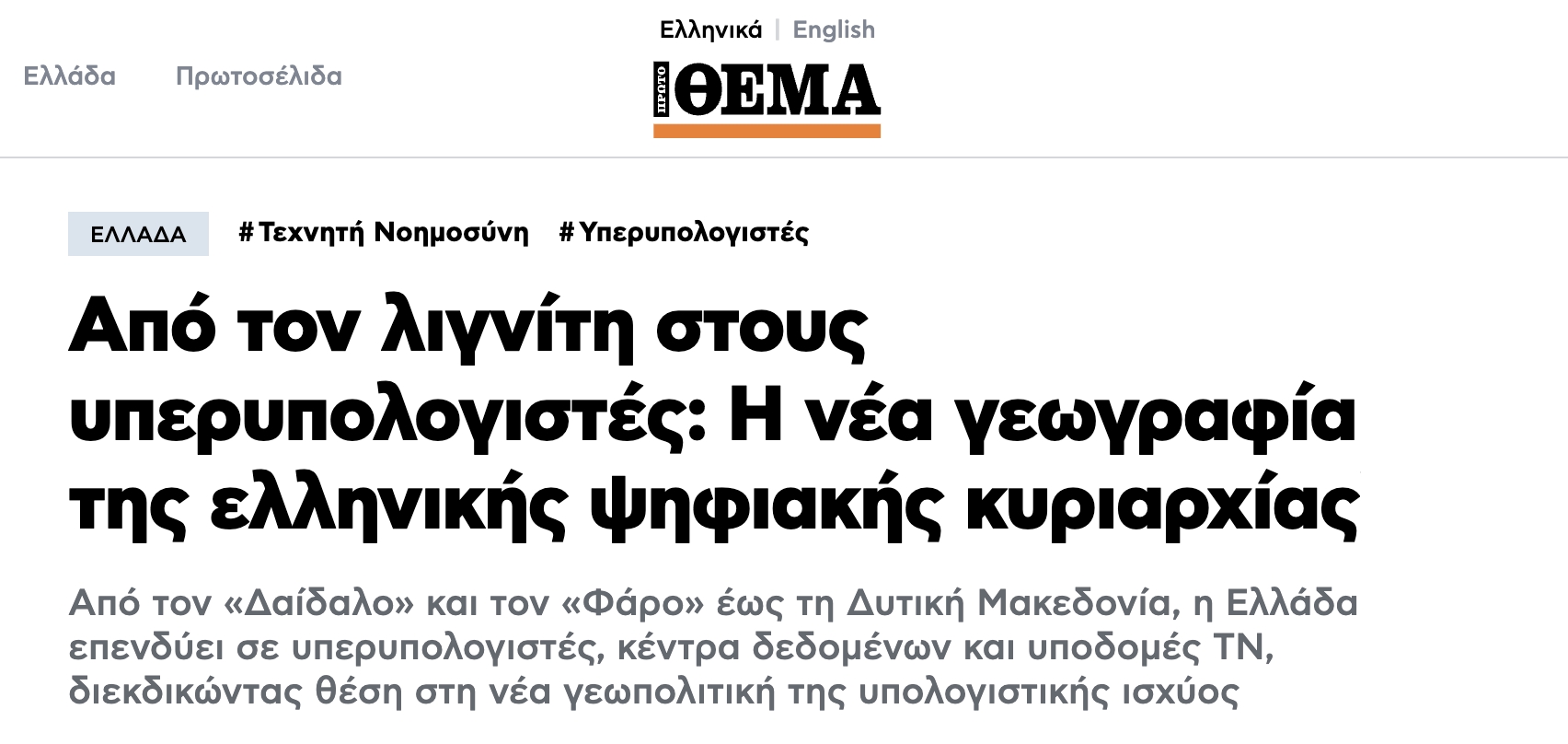
A new opinion piece published by Proto Thema, co-authored by Spyros-Nikitas Tsamichas, Co-Founder of Energon Green Solutions and Digital World Summit Greece Editor in Chief & Ioannis Antoniadis, Vice-Rector of the University of Western Macedonia, examines one of the most consequential questions facing Greece’s technological future: who will own, control, and access the computing power that will drive the coming decade.

Behind the public conversation about artificial intelligence sits a quieter but decisive issue. As the authors argue, the debate over AI ultimately rests on infrastructure, on the supercomputers, data centres, and energy systems that determine whether a nation participates in the digital economy as a sovereign actor or as a dependent one. At the core of that infrastructure lies a question of energy: computing power at scale demands power generation at scale, and the source of that power will shape both the sustainability and the sovereignty of the systems it feeds.

The article focuses on Western Macedonia, a region historically defined by lignite. The phase-out of lignite, the authors contend, is shifting from an environmental obligation into a strategic opportunity. Where coal once anchored the regional economy, a new configuration is emerging: public high-performance computing (HPC), a European AI Factory, a private hyperscaler, and abundant green energy. Together, these elements form what the authors describe as a single “square” of digital sovereignty, one in which clean energy is not an afterthought but the foundation.

The central question the piece raises is whether Greece will treat these developments as one coherent national strategy rather than as separate, uncoordinated projects. The distinction matters. A fragmented approach risks leaving valuable assets underutilised and strategic advantages unrealised, while an integrated framework could position the country and Western Macedonia in particular as a meaningful node in Europe’s digital infrastructure, powered by renewable rather than fossil sources.

The piece situates this discussion within the wider work of the Digital World Summit Greece, the country’s official national initiative for the democratic governance of emerging technologies, which seeks to shape policy proposals responsive to societal needs and to keep citizens informed of current developments.

The convergence of energy, technology, and sustainability described in this article lies at the heart of Energon Green Solutions. As a legaltech and clean-energy venture, Energon Green Solutions works at the intersection of renewable energy, digital innovation, and the regulatory frameworks that govern them precisely the terrain on which Greece’s digital sovereignty will be built. The data centres, HPC facilities, and AI infrastructure now taking shape in regions like Western Macedonia will depend on green power, sound governance, and informed legal and policy guidance. Energon Green Solutions is positioned to support this transition, helping bridge the gap between sustainable energy and the digital systems it must power.

Read the full article here: https://www.protothema.gr/greece/article/1835094/apo-ton-ligniti-stous-uperupologistes-i-nea-geografia-tis-ellinikis-psifiakis-kuriarhias/?shem=rimspwouoe&fbclid=IwY2xjawSc72BleHRuA2FlbQIxMABicmlkETFlNlRSdUxURk9ZVmxGZHNuc3J0YwZhcHBfaWQQMjIyMDM5MTc4ODIwMDg5MgABHv0qXEe2PeV1N1Wm4JvMHFEpSmmJ_rETAAs8jjmsypxbrQvfLaSNVVNzYGhD_aem_IoL4o96AGYUJXa4R58QMpw


The full article appears below in English translation.

From Lignite to Supercomputers: The New Geography of Greek Digital Sovereignty

By Ioannis Antoniadis, Vice-Rector for Administrative and Financial Affairs of the University of Western Macedonia, and Spyros-Nikitas Tsamichas, Editor-in-Chief of the Digital World Summit Greece.

Behind the public conversation about artificial intelligence lies a quieter but decisive question: who owns, who controls, and who gains access to the computing power that will fuel the next decade. Greece, through a small but rapidly growing archipelago of infrastructure, is beginning to shape its own answer.

Supercomputers are not simply faster computers. They are systems of thousands of interconnected processors operating in parallel, enabling the training of AI models, simulations of climate systems, drug discovery, the development of quantum algorithms, and cybersecurity at scales that traditional data centres cannot support. In this production chain, hardware ceases to be indifferent equipment: it is the spatial footprint of technological power.

The European Commission has begun to grasp this equation with a clarity that was absent in earlier cycles. The International Digital Strategy, presented in June 2025, establishes digital sovereignty as an explicit strategic objective, not as a defensive slogan but as a structural condition, so that Europe can shape its own digital choices in line with its own values. Translating that commitment into hardware runs through the EuroHPC Joint Undertaking, which since 2020 has coordinated public and private investment and pooled resources so that the EU need not depend on American or Chinese supercomputing ecosystems. It was on this logic that the AI Factories were built: not merely supercomputers, but complete ecosystems around machines specifically optimised for AI, with data centres, services, and regular upgrades to the computing stack.

In January 2026, the Council went a step further. The amendment of the EuroHPC Regulation established two new pillars: AI gigafactories, large-scale facilities combining high-performance computing, energy-efficient data centres, and AI-driven automation, and quantum technologies, which are expected to enable problem-solving, materials design, drug discovery, and network optimisation in areas where classical supercomputers reach their limits. The EU, in other words, is not confining itself to reaching the current technological frontier; it is designing the next one.

Greek Infrastructure

Within this European framework, Greece has developed a network of infrastructure that is unusually dense for its size. The National Infrastructures for Research and Technology (GRNET) holds a decade of specialised expertise in HPC systems, having operated the ARIS supercomputer since 2015. Today it is building “Daedalus” at Lavrio, a systemic feat of more than 89 petaflops with a total budget of €58.9 million, 35% from the EuroHPC Joint Undertaking and 65% from “Greece 2.0” / NextGenerationEU. It is EuroHPC’s tenth investment in a national supercomputer, with Hewlett Packard Enterprise as contractor and an international consortium that includes Cyprus, North Macedonia, and Montenegro. Lavrio thus emerges as a new HPC footprint for South-Eastern Europe.

Built upon this infrastructure is “Pharos,” one of the EU’s first seven AI Factories. With a budget of €30 million, co-financed 50/50 by EuroHPC and national resources and coordinated by GRNET, Pharos brings together a consortium that includes Demokritos, the National Technical University of Athens, the “Athena” Research Centre, CERTH, the Aristotle University of Thessaloniki, the National and Kapodistrian University of Athens, FORTH, the University of Piraeus, the Growthfund, and the General Secretariat for Strategic Planning. Its task is to convert Daedalus’s computing power into applications for health, the Greek language and culture, and sustainability, and to serve as Greece’s vehicle for compliance with the AI Act.

In parallel, the private sector is moving quickly. Microsoft is building its first data centre in Greece, at Spata. The PPC group has incorporated into its strategic investment plan the creation of a green energy and technology hub featuring a large data centre and an AI gigafactory, a natural extension of decarbonisation into a new industrial model. Public HPC, a European AI Factory, a private hyperscaler, and green regional infrastructure are not separate projects. They are the corners of a single square of digital sovereignty, one maturing in ways that would not have been easily foreseeable five years ago.

Why Western Macedonia

Western Macedonia’s involvement is not incidental. In October 2025, through a Joint Announcement by the Ministries of National Economy and Finance, of Digital Governance, and of Artificial Intelligence, together with the Region of Western Macedonia, the intention to create a new AI Supercomputer in the area with national resources was made official. This is a dual decision: energy-related and industrial. Western Macedonia possesses what most European regions lack: abandoned industrial land with high-voltage connections, specialised technical personnel from PPC, and a university that has already shifted its scientific weight toward energy systems and computing, reinforcing the goal of a just transition.

In this environment, the University of Western Macedonia does not merely act as an academic observer of the transition, but as an institutional accelerator of it. With research activity in energy systems, computing, artificial intelligence, technology management, and sustainable development, it can connect the new computing infrastructure to the real needs of the region, the public administration, and the productive economy.

The Green Data Centre and Supercomputer of the University of Western Macedonia, currently under construction in synergy with GRNET as co-beneficiary, functions as a testing ground for this transition. It is not only a technical facility, but a model regional laboratory for how computing power can be combined with cleaner energy, energy efficiency, research applications, and the development of digital skills. In a region that for decades underpinned the country’s energy security, the University can help ensure that the new phase rests not only on the installation of infrastructure, but on the creation of knowledge, human capital, and innovation around it.

In an era when “where” a data centre is built is determined by energy costs, water availability, and networking speed, the region begins with serious comparative advantages. The corresponding risk, of course, is real: if these advantages are not translated in time into mature investment decisions, the transition could become the belated hosting of infrastructure designed elsewhere. The siting of the new AI Supercomputer in Western Macedonia therefore acquires particular significance, especially when it is connected to the region’s University. The University can act as a bridge between national infrastructure, the research community, businesses, and the needs of local society, transforming the supercomputer from an isolated technical project into a development ecosystem.

The challenge, then, is not only to install infrastructure in Western Macedonia. It is to shape around it a living ecosystem of knowledge, education, research, entrepreneurship, and public policy. This is the particular contribution the University of Western Macedonia can make: to transform digital sovereignty from an abstract national strategy into a concrete regional development opportunity.

Open Questions

Behind the announcements and the funding, the questions that truly matter are those preoccupying Brussels, Paris, and Berlin alike. How is “real,” rather than nominal, digital sovereignty secured when the chips, the frameworks, and many of the foundation models remain American or Taiwanese? Oversight of the infrastructure does not guarantee oversight of the computing stack.

How are climate targets reconciled with the explosive energy demand of data centres, especially when the AI gigafactories the EU is planning will require orders of magnitude more power than today’s systems? And who, ultimately, gains meaningful access to the resources of an AI Factory: large companies with the technical and legal capacity to exploit state-supported compute, or the start-ups and research teams who are the explicit reason such programmes exist? The stakes are not theoretical: it is about not reproducing, on a European scale, the asymmetry of Silicon Valley, this time with public money.

The new quantum pillar moves in the same direction. Beyond the promise of new capabilities, it opens a parallel field of sovereignty in which Europe still has the chance not to fall behind from the outset, if it acts with the speed and coordinated funding it demonstrated in the AI Factories pillar.

Greece’s Position

The Greek case displays a rare internal coherence. At Lavrio, the hardware is being put in place. Within the structures of Pharos, applied use is being built. At Spata, private hyperscaling meets domestic demand. In Kozani and Western Macedonia, the country’s first genuinely new industrial cycle in decades may be born. Western Macedonia does not simply need to host the country’s new computing power. It needs to connect that power to knowledge, human resources, green energy, and productive reconstruction. This is the role the University of Western Macedonia can assume.

The question is whether these corners will remain separate, or whether Greece will handle them as a single strategic line. The difference determines whether the country negotiates digital sovereignty as a state that builds sovereign infrastructure, or merely as a state that hosts it.

This piece is published on the occasion of the event “Supercomputers and Digital Sovereignty,” organised by the University of Western Macedonia in collaboration with the Digital World Summit Greece. The event forms part of the third cycle of the DWSG initiative, which serves as the Greek hub of the UN’s Internet Governance Forum and feeds policy proposals to the European Commission and the Ministry of Digital Governance.

Energon Green Solutions was proud to take part in Posidonia 2026, the world’s leading shipping exhibition, held from 1–5 June 2026 at the Metropolitan Expo in Athens, Greece. Convening shipowners, energy innovators, technology providers, financiers and policymakers from across the globe, Posidonia has become the strategic meeting point where the maritime industry charts its course toward a sustainable, decarbonised future.

Why Posidonia Matters to the Energy Transition

Hosted in the country that operates the world’s largest merchant fleet, Posidonia is far more than a trade fair, it is the compass of international shipping. Held under the auspices of the Hellenic Ministry of Maritime Affairs, the Hellenic Chamber of Shipping, and the Union of Greek Shipowners, the summit brings together the people and technologies shaping how the global fleet will be powered for decades to come.

This year, decarbonisation was at the centre of the conversation. From alternative marine fuels and biofuels to energy efficiency, electrification, and the digital transformation of the fleet, Posidonia 2026 made clear that shipping’s green transition is no longer aspirational, it is operational. As the President of the Union of Greek Shipowners reminded the industry, shipping remains the backbone of global prosperity, and its resilience now depends on building a genuinely sustainable future.

Energon Green Solutions’ Relevance to Maritime Decarbonisation

The maritime sector is one of the hardest-to-abate industries on the planet, and that is precisely where Energon Green Solutions sees both responsibility and opportunity. As a company dedicated to advancing clean energy and sustainability, Energon attended Posidonia 2026 to connect the green energy economy with one of the world’s most critical and energy-intensive industries.

Our presence reflected Energon’s commitment to supporting shipping’s transition across several converging fronts:

  • Alternative and renewable energy solutions — bridging green energy innovation with the maritime sector’s growing demand for cleaner power and lower-carbon fuels.
  • Energy efficiency and decarbonisation strategy — helping maritime stakeholders understand and act on the pathways to compliance.
  • Sustainability and the green transition — aligning shipping’s environmental obligations with practical, scalable clean-energy approaches.
  • Knowledge and capacity building — through Energon’s educational initiatives, supporting the skills and understanding the industry needs to navigate the energy transition with confidence.

Building Partnerships for a Sustainable Maritime Future

Attending Posidonia 2026 allowed Energon Green Solutions to engage directly with shipowners, technology developers, and policymakers tackling the defining challenge of the maritime century: how to keep the world’s fleet moving while dramatically cutting its emissions. The discussions on alternative fuels, energy efficiency, and digitalisation reaffirmed that collaboration between the energy and shipping sectors is essential and that companies positioned at that intersection have a vital role to play.

Looking Ahead

Posidonia 2026 closed on a high, reaffirming Greece’s central role in global maritime affairs and the growing urgency of the industry’s green agenda. Energon Green Solutions looks forward to continuing to support the maritime sector and the wider economy on the path toward cleaner energy, lower emissions, and a more resilient, sustainable future.

Advancing Innovation, Technology & International Cooperation Between Greece and Italy

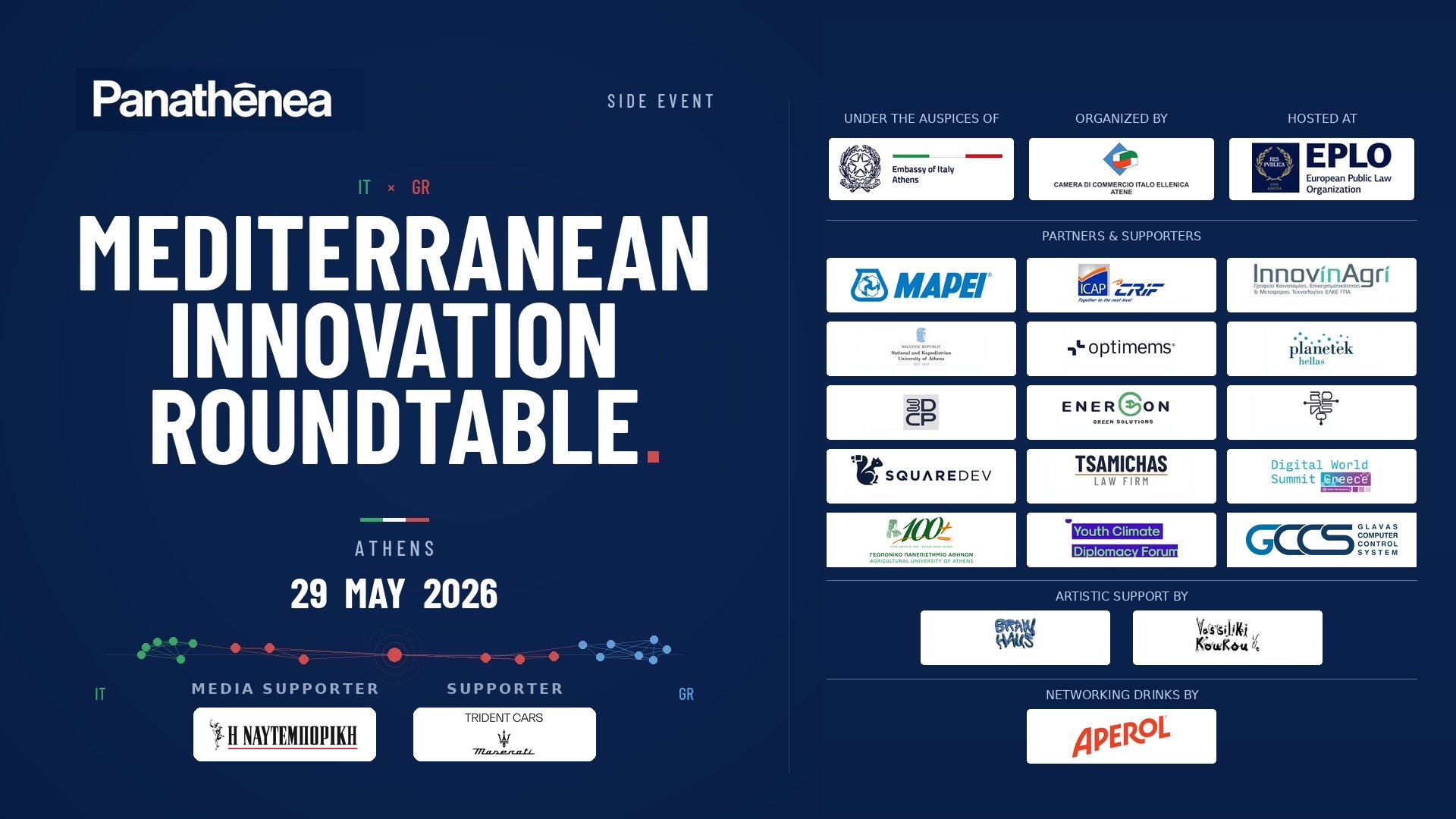
Energon Green Solutions proudly participated in the Mediterranean Innovation Roundtable, an official side event of the Panathēnea Festival 2026, organized by the Camera di Commercio Italo-Ellenica di Atene under the auspices of the Italian Embassy in Athens and hosted at the European Public Law Organization (EPLO).

The event brought together distinguished leaders, innovators, entrepreneurs, policymakers, academics, and industry experts from Greece and Italy to explore emerging opportunities in technology, innovation, sustainability, and culture across the Mediterranean region.

The discussion focused on a broad spectrum of cutting-edge sectors, including Artificial Intelligence, Space Technology, AgriTech, ESG innovation, Digital Art, Climate Technology, and Advanced Manufacturing through 3D Printing. The Roundtable provided a platform for the exchange of ideas, best practices, and potential bilateral collaborations capable of generating long-term economic and societal value.

A significant milestone of the event was the signing of a Memorandum of Understanding (MoU) between the European Public Law Organization (EPLO), represented by its President, Professor Spyridon Flogaitis, and the Camera di Commercio Italo-Ellenica di Atene, represented by its President, Cav. Avv. Ioannis Tsamichas. The agreement establishes a framework for future cooperation in education, research, innovation, and academic exchange throughout the European Union, reinforcing the strategic relationship between the two institutions.

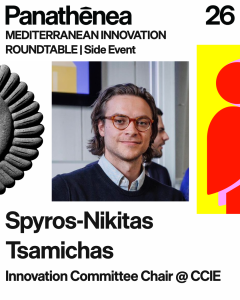
The Roundtable was moderated by Spyros-Nikitas Tsamichas, Managing Partner of Tsamichas Law Firm, Chair of the Innovation & Technology Committee of the Hellenic-Italian Chamber of Commerce in Athens, and Co-Founder of Energon Green Solutions. In his remarks, he emphasized the importance of fostering cross-border innovation ecosystems and strengthening collaboration between public institutions, academia, and the private sector to address the challenges of the digital and green transitions.

The event featured contributions from an outstanding panel of innovators and industry leaders, including representatives from:

  • ICAP CRIF
  • Planetek Hellas
  • Optimems
  • InnovinAgri – Office of Technology Transfer & Entrepreneurship
  • SquareDev
  • Digital World Summit Greece
  • Youth Climate Diplomacy Forum for Southeast Europe
  • 3DCP Greece
  • Braw Haus

Through their presentations, participants showcased pioneering initiatives and technological developments that are shaping the future of sectors ranging from finance and agriculture to aerospace, sustainability, and digital transformation.

The success of the Mediterranean Innovation Roundtable demonstrates the growing importance of international cooperation in fostering innovation-led growth and strengthening ties between Greece and Italy. It further highlights the role that legal, business, academic, and technological institutions can play in creating meaningful partnerships that support sustainable development and economic progress.

Energon Green Solutions remains committed to supporting initiatives that encourage innovation, entrepreneurship, international cooperation, and the responsible development of emerging technologies. As legal advisors operating at the intersection of business, technology, and international affairs, the Firm continues to actively contribute to discussions and projects that shape the future of the Mediterranean innovation ecosystem.

We extend our sincere appreciation to all speakers, partners, organizers, and supporters whose contributions ensured the success of this landmark event and look forward to future collaborations that further strengthen the innovation bridge between Greece and Italy.

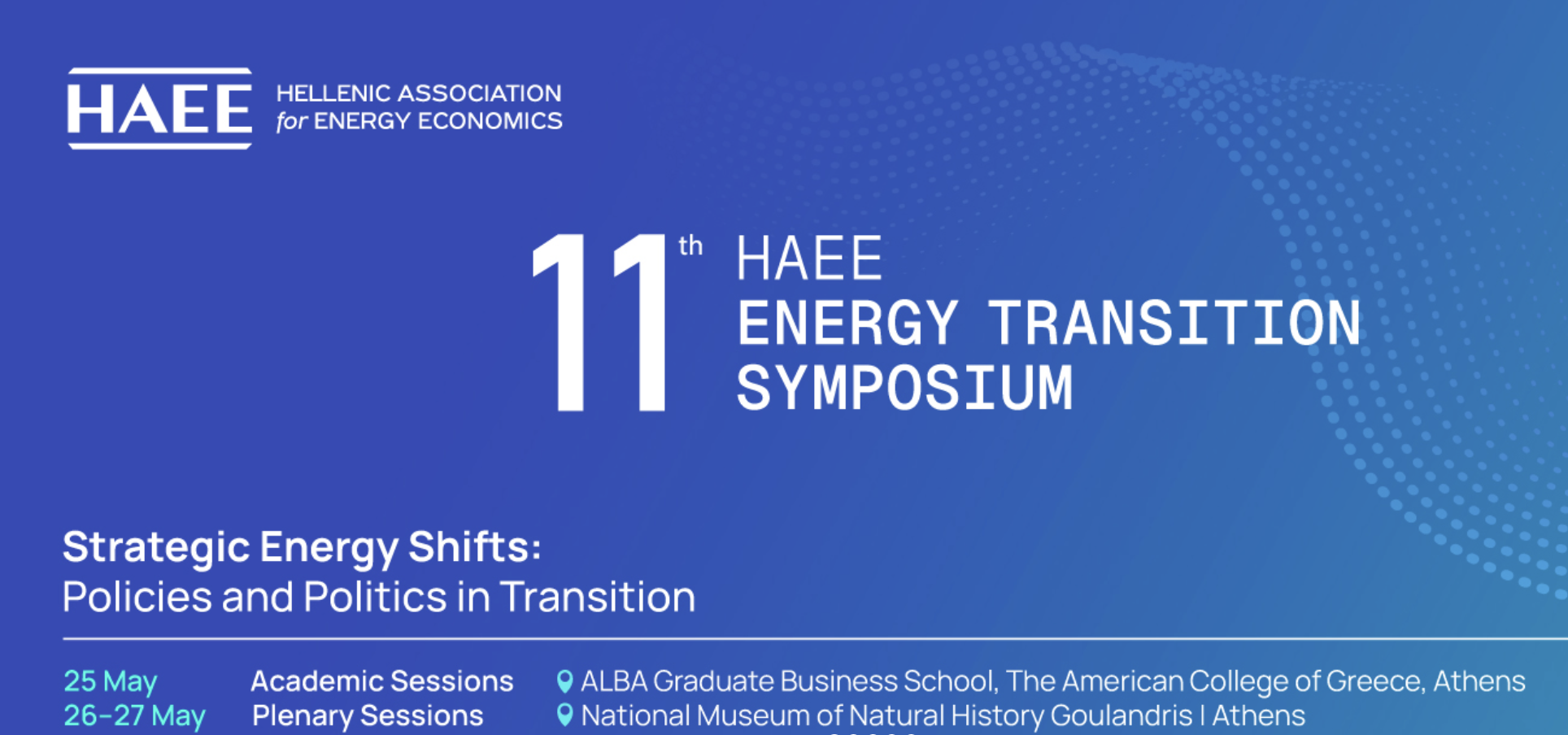
Energon Green Solutions was represented this week at the 11th HAEE Energy Transition Symposium, held at ALBA Graduate Business School, American College Greece, under the theme “Strategic Energy Shifts: Policies and Politics in Transition.”

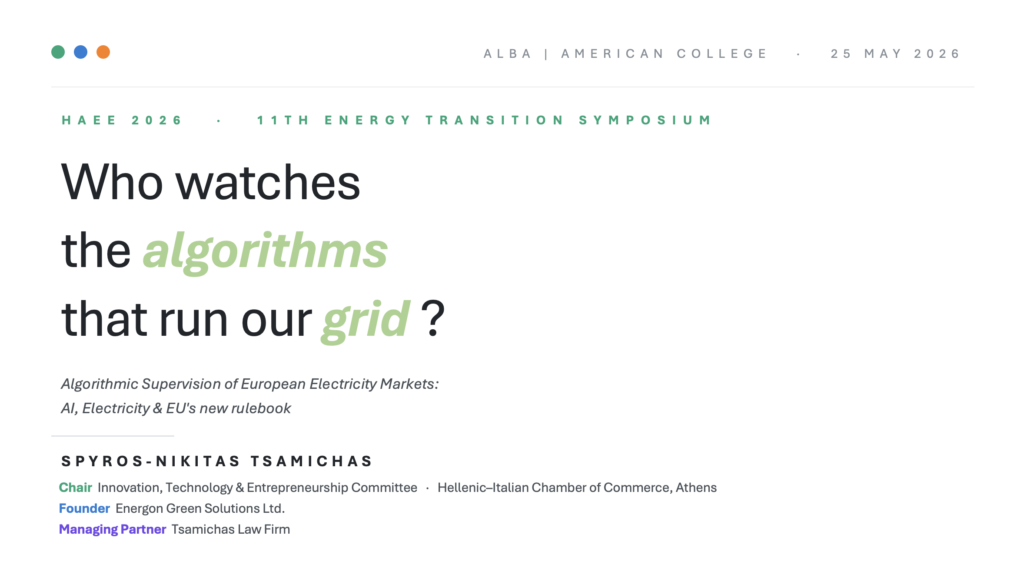
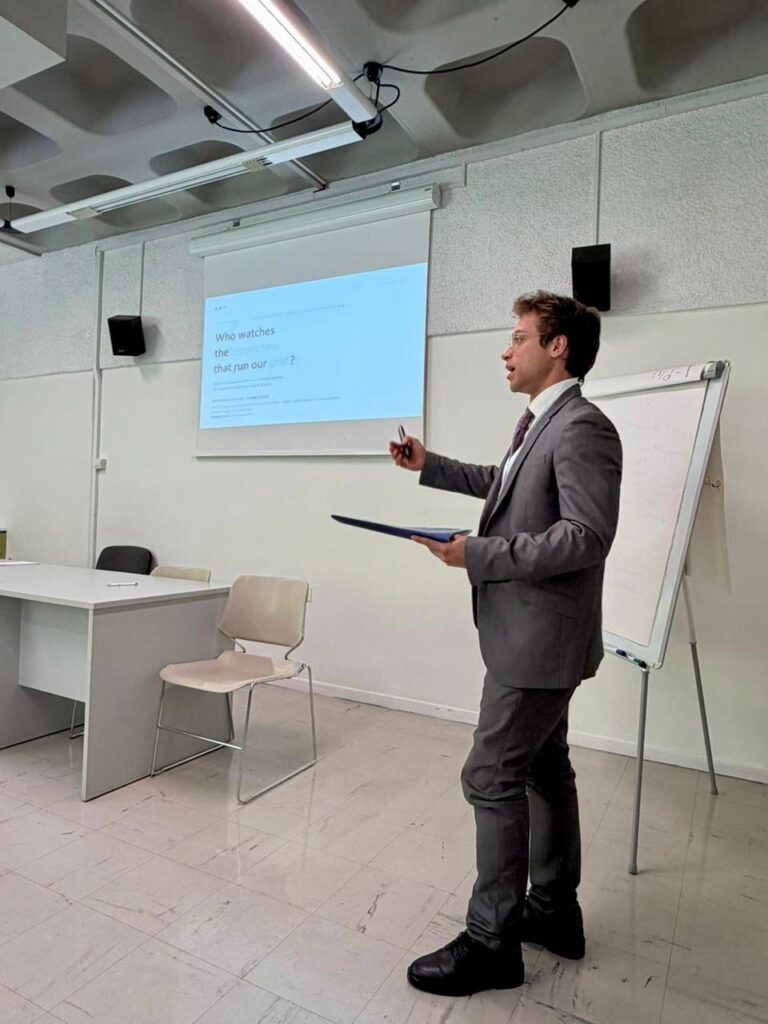
Spyros-Nikitas Tsamichas, presented the research paper “Algorithmic Supervision of European Electricity Markets,” co-developed with the Youth Climate Diplomacy Forum (YCDF), as part of Session III: Governance, Strategic Risk and Emerging Technologies in the Energy Transition.

The Symposium, organised annually by the Hellenic Association for Energy Economics, brings together academics, regulators, industry leaders, and policymakers from across Europe and beyond to debate the strategic direction of the European energy transition. The 2026 edition was hosted across ALBA Graduate Business School and the National Museum of Natural History Goulandris in Kifissia, with academic sessions on May 25 and plenary sessions on May 26–27.

The Paper

The Energon Green Solutions × YCDF paper addresses what its authors describe as the most pressing unresolved question in European energy regulation: how to govern AI systems that now operate the European electricity grid in real time, while four major and partially overlapping pieces of EU legislation impose distinct, sometimes contradictory, compliance obligations on those same systems.

The 3 instruments the EU AI Act (2024), the NIS2 Directive (2022), the Data Act (2023) converge on the algorithms running Europe’s transmission grids, but were drafted by different regulators, on different timelines, and with limited cross-coordination.

At its core sits what the authors call the 200-millisecond paradox: Article 14 of the AI Act requires “meaningful human oversight” of high-risk AI, yet the algorithms balancing the European grid must detect and respond to disturbances within roughly 200 milliseconds — far faster than any human reviewer can meaningfully intervene. The two requirements, the paper argues, are technically irreconcilable under a strict reading of current law.

Drawing on case studies from Terna (Italy), TenneT (Netherlands / Germany), Red Eléctrica (Spain), and IPTO / ADMIE (Greece), and benchmarked against the January 2021 Continental European grid split, the paper proposes an Algorithmic Energy Governance (AEG) framework built on three layers: Classify, Automate, Coordinate.

The accompanying cost modelling indicates that, on current regulatory trajectory, administrative compliance costs across the instrumentsl could double by 2030, and that an automated governance approach could reduce that burden by up to 50%. Counterfactual welfare estimation, calibrated to ACER data, suggests that delayed grid responses at major cross-border interconnectors could account for foregone load-shed value of up to €18 million per event.

Session and Acknowledgements

Session III was chaired by Prof. Kyriaki Kosmidou, Director, Postgraduate Studies in Master in Business Administration (MBA), Aristotle University of Thessaloniki, and Steering Committee member of the HELLENiQ ENERGY Center for Sustainability & Energy @Alba Graduate Business School. The session also featured Dr. Maria Lykidi’s presentation on “The Role of Small Modular Nuclear Reactors in the Energy Transition,” alongside contributions on risk management in the energy transition and waste heat recovery in naval applications.

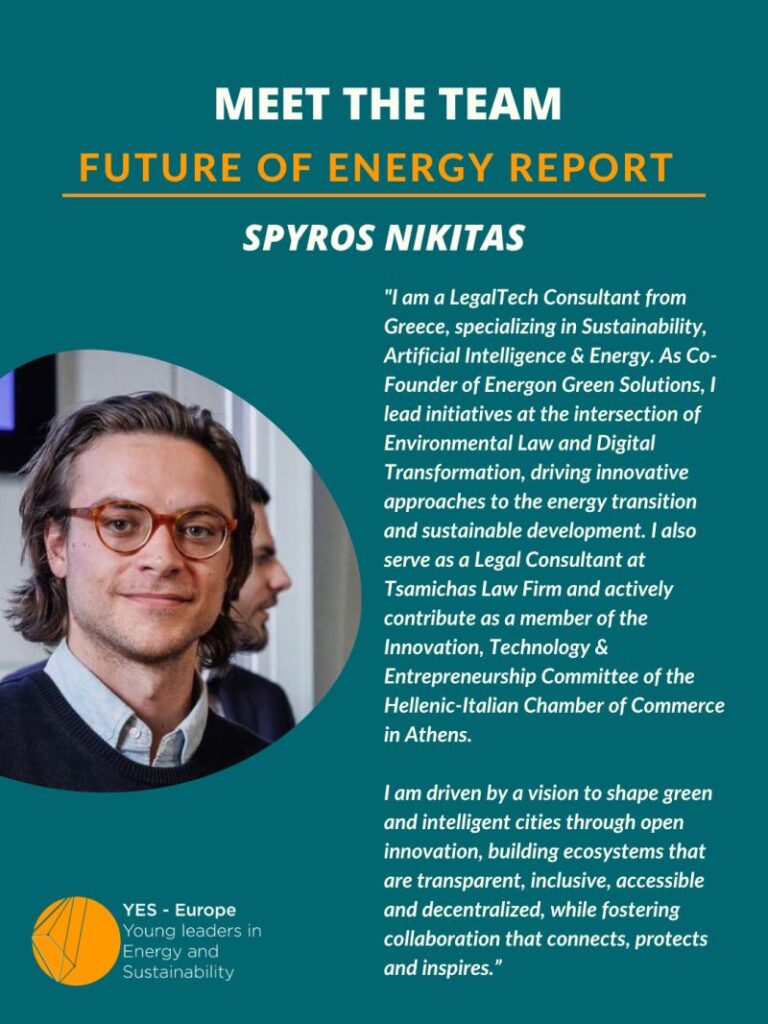
We are pleased to announce that Spyros-Nikitas Tsamichas, founder of Energon Green Solutions, has been appointed Co-Editor of the 2026 edition of the YES-Europe Future of Energy (FOE) Report, alongside Julian Kristensen Nilsen.

The FOE Report is YES-Europe’s flagship analytical publication. Since 2016, it has served as the principal platform through which the perspectives of Energy Students and Young Professionals (ESYPs) across the continent are consolidated, peer-reviewed, and surfaced to senior decision-makers in European energy policy, industry, and finance. It is one of the few continent-wide initiatives that takes the analytical voice of the next generation of energy leaders seriously and treats it as policy-relevant input rather than commentary.

Spyros joins the editorial team having contributed as an author to last year’s edition. The transition from author to co-editor reflects both the depth of his engagement with the YES-Europe network and the analytical contribution he is making to the European energy debate, particularly at the increasingly important intersection of energy transition, regulatory infrastructure, and digital infrastructure delivery.

The 2026 Edition: Challenges of the Energy Transition

The 2026 FOE Report will curate high-level academic, scientific, and policy contributions on the Challenges of the Energy Transition, with a particular focus on where the transition is most structurally constrained today. Editorial priorities for this year’s edition include:

  • Policy execution — permitting reform, regulatory throughput, and the gap between EU-level ambition and Member State implementation capacity
  • System integration — grid capacity, flexibility markets, and the absorption of structural demand growth from electrification, reindustrialisation, and digital infrastructure
  • Innovation and deployment — the conditions under which mature and emerging technologies actually scale within Europe’s institutional framework

The editorial bar is straightforward: analytical rigour, policy relevance, and a clear point of view.

Why This Matters for Energon

The questions the 2026 FOE Report will examine are the same questions that define Energon Green Solutions’ work.

Europe’s energy transition has moved from a question of ambition to a question of execution. The binding constraints today are no longer targets, technology, or capital, they are legal, regulatory, and procedural. Permitting velocity, regulatory throughput, and the institutional capacity to deliver complex infrastructure at scale are now determining variables for whether the continent’s climate commitments are actually achievable.

Energon was built around this thesis. Spyros’s editorial role on the FOE Report places that thesis in dialogue with researchers, practitioners, and young professionals across Europe who are working on the same problem from different vantage points — and ensures that the insights shaping the next generation of European energy policy are informed by the realities of how the system actually delivers.

Engagement and Contributions

The 2026 FOE Report is now open for engagement with contributors, reviewers, and partners across the YES-Europe network and beyond.

If you are conducting research, leading initiatives, or developing policy positions at the frontier of the European energy transition, particularly on the regulatory, permitting, and institutional dimensions, we would welcome the conversation.

🔗 Learn more about the Future of Energy Report: https://yeseurope.org/projects/reports/

At Energon Green Solutions, we believe that innovation begins with knowledge—and that strong research is the foundation of meaningful impact. As part of this vision, we are proud to highlight an initiative that equips young minds with the tools to enter the world of academic and applied research with confidence.

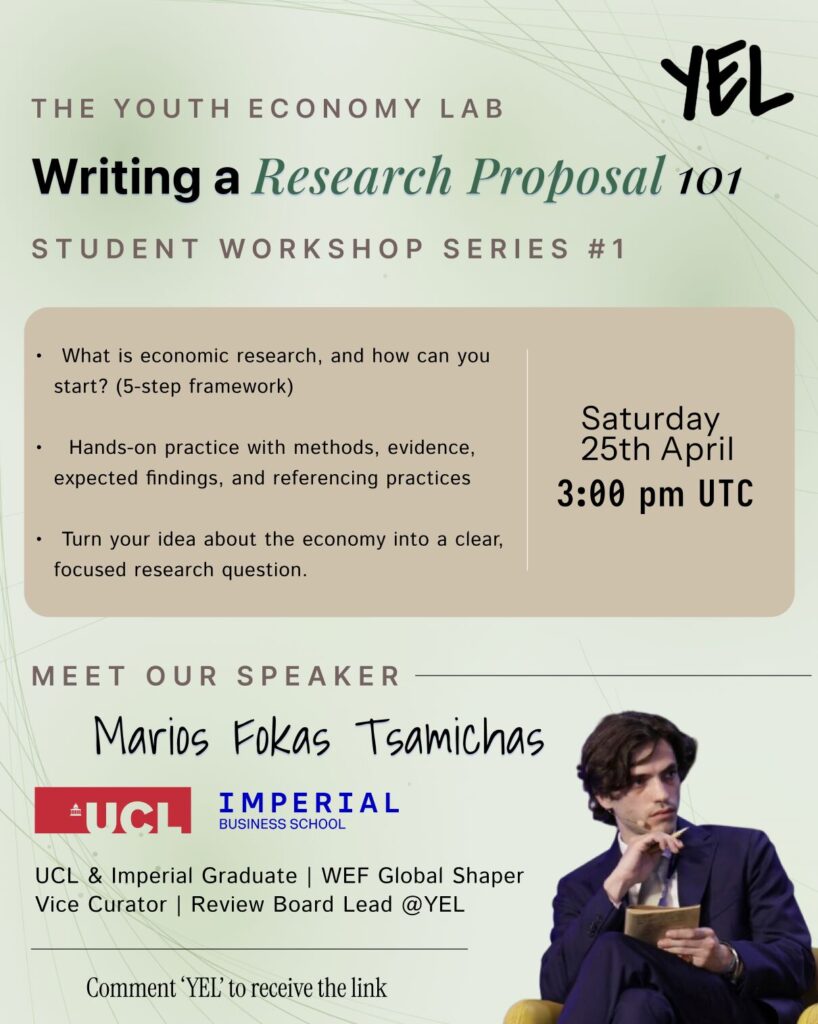
The Youth Economy Lab (YEL) is hosting its flagship session, “Writing a Research Proposal 101,” designed to guide students through the essential steps of transforming ideas into structured, compelling research proposals.

Bridging Ideas with Real-World Impact

The workshop will be led by Marios Fokas Tsamichas, co-founder of Energon Green Solutions, who combines academic excellence with practical expertise in economics, law, and innovation. A graduate of both University College London and Imperial College Business School, Marios brings a multidisciplinary perspective to research—one that aligns academic rigor with real-world applicability.

Participants will gain insight into:

  • How to approach economic and interdisciplinary research from the ground up
  • A structured 5-step framework for developing research proposals
  • Practical methods for defining research questions, structuring arguments, and presenting expected findings
  • Best practices in academic referencing and evidence-based writing

Unlocking Global Opportunities

Beyond foundational skills, the session will also provide strategic guidance on accessing international research opportunities. Attendees will learn how to position themselves for competitive programs, including opportunities to collaborate with professors from leading institutions such as Massachusetts Institute of Technology and Stanford University through the YEL Student Scholars Contest.

For students aiming to build a career in research, policy, or innovation-driven sectors—such as legaltech, sustainability, and energy transition—this workshop offers a valuable entry point.

Why This Matters for LegalTech and Sustainability

At Energon Green Solutions, we recognize that the future of legal and energy systems depends on interdisciplinary thinking. Research is not just an academic exercise—it is a tool for shaping regulation, advancing sustainable technologies, and addressing complex societal challenges like energy poverty and climate governance.

By supporting initiatives like YEL, we actively contribute to building a new generation of professionals capable of bridging law, technology, and sustainability through evidence-based solutions.

Event Details

  • Date: Saturday, 25th April
  • Time: 3:00 p.m. (UTC)
  • Format: Online webinar
  • Access: Free for high school students, university students, and recent graduates

Participants can join the session and gain access to the YEL community by registering through the official channels.

Strong research skills are no longer optional—they are essential. Whether you are exploring academic pathways or aiming to innovate within sectors like legaltech and sustainable energy, learning how to craft a compelling research proposal is a decisive first step.

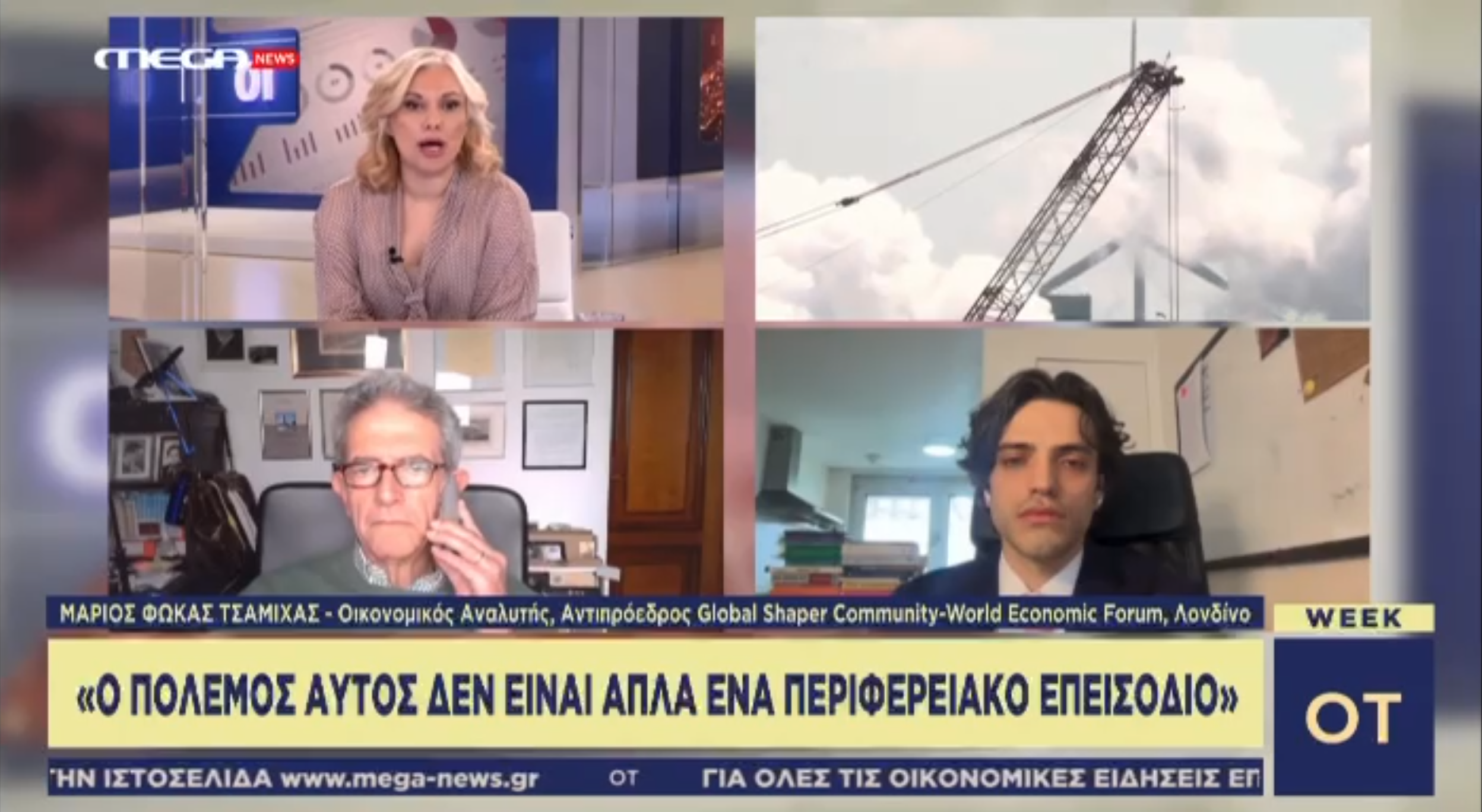
We are pleased to highlight the recent media appearance of our Co-Founder, Marios Fokas Tsamichas, who participated in a high-level discussion on the Greek economic program “Οικονομικός Ταχυδρόμος”on Mega TV.

The discussion, moderated by distinguished journalist Athanasia Akrivou, brought together leading voices in the field, including environmental engineer Prof. Nikos Moussiopoulos, to examine one of the most pressing challenges of our time: the multidimensional global energy crisis.

A Crisis Beyond Energy: A Systemic Global Challenge

The conversation emphasized that today’s energy crisis is not merely a matter of supply and demand. It is a structural, geopolitical, and economic phenomenon with far-reaching implications.

Key drivers identified include:

  • The persistent overdependence on imported fossil fuels, particularly within European economies
  • Intensifying geopolitical tensions, which continue to disrupt energy markets and supply chains
  • The strategic vulnerability of nations lacking energy autonomy and infrastructure resilience

As highlighted during the discussion, energy is no longer just a commodity—it is a core pillar of national security and economic sovereignty.

Macroeconomic Risks: Inflation, Trade Disruption, and Recession

A central theme of the interview was the growing intersection between energy instability and macroeconomic fragility.

The panel addressed the increasing likelihood of:

  • Sustained inflationary pressures driven by volatile energy prices
  • Disruptions in global trade and shipping, particularly in sensitive geopolitical regions
  • A potential global economic slowdown or recession, exacerbated by prolonged conflict and energy uncertainty

For businesses and policymakers alike, these risks underscore the urgent need for forward-looking, legally robust, and economically sound strategies.

Energy Transition as a Legal, Strategic, and Technological Imperative

A key message emerging from the discussion—and one that lies at the core of Energon Green Solutions’ mission—is clear:

The transition to low-carbon, flexible, and resilient energy systems is no longer optional—it is imperative.

This transition, however, is not purely technological. It requires:

  • Regulatory innovation and adaptive legal frameworks
  • Strategic infrastructure investments aligned with EU and international energy policy
  • Digital and legal-tech solutions to support compliance, transparency, and scalability

Energon’s Perspective: Bridging Law, Technology, and Sustainability

At Energon Green Solutions, we recognize that the future of energy lies at the intersection of:

  • Legal certainty
  • Technological innovation
  • Sustainable investment models

The insights shared by our Co-Founder reinforce our commitment to developing legal-tech solutions that empower energy stakeholders, facilitate energy transition projects, and ensure alignment with evolving EU and global regulatory frameworks.

In an increasingly complex energy landscape, legal intelligence and technological integration are no longer complementary, they are foundational

Looking Ahead

The global energy crisis presents undeniable challenges, but also a historic opportunity to reshape energy systems into ones that are resilient, decentralized, and sustainable.

Energon Green Solutions remains at the forefront of this transformation, contributing to a future where law, innovation, and sustainability converge to create lasting impact.

See full interview here: https://www.megatv.com/etvshows/2311471/21-03-26-2/

Introduction: LegalTech Meets Climate Action

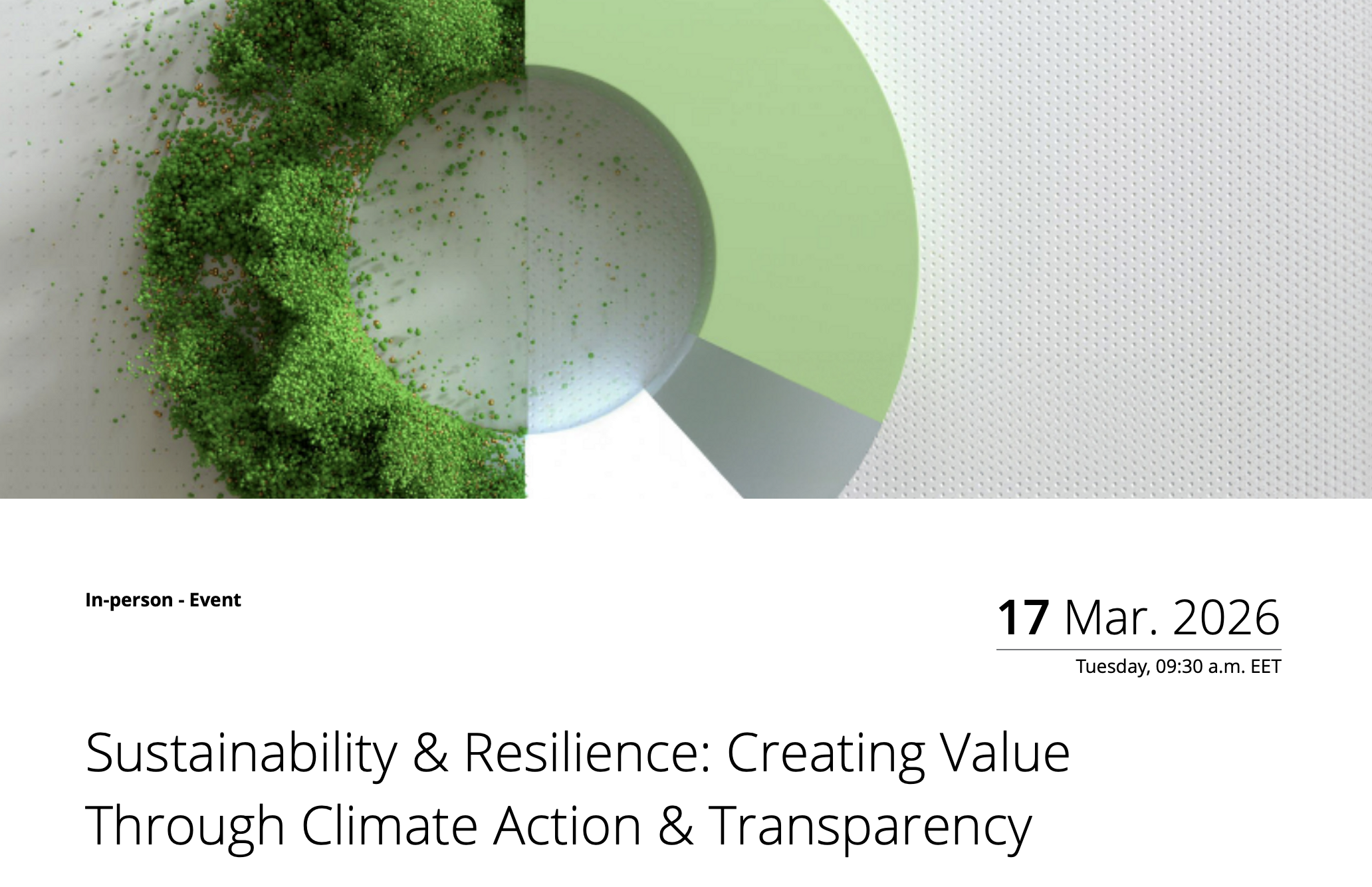
On 17 March 2026, Energon Green Solutions attended Deloitte Greece’s high-level forum, “Sustainability & Resilience: Creating Value Through Climate Action & Transparency.”

The event brought together leaders across law, finance, energy, and policy, highlighting a defining reality of the modern economy: climate action and ESG compliance are rapidly becoming programmable, data-driven, and legally enforceable ecosystems.

Energon Green Solutions’ participation reflects its mission to bridge law, technology, and sustainability, positioning itself at the forefront of smart contract infrastructure and tokenised ESG systems.

From ESG Compliance to Programmable Law

A central theme of the forum was the transition from static compliance frameworks to dynamic, real-time regulatory systems.

Energon Green Solutions addresses this shift through LegalTech architecture, enabling:

  • Smart contracts for ESG compliance automation
  • Real-time monitoring of sustainability obligations
  • Reduction of legal uncertainty through code-based execution

This represents a paradigm shift from traditional legal enforcement to “programmable compliance”, where obligations under frameworks such as:

  • Corporate Sustainability Reporting Directive (CSRD)
  • EU Taxonomy Regulation
  • Sustainable Finance Disclosure Regulation (SFDR)

can be translated into automated, verifiable, and auditable digital processes.

Tokenisation of Sustainability and Climate Assets

Energon Green Solutions is actively developing solutions for the tokenisation of sustainability-linked assets, a concept that aligns with the forum’s focus on transparency and value creation.

Tokenisation enables:

  • Fractional ownership of energy assets (e.g., renewable infrastructure)
  • Digital representation of carbon credits and ESG metrics
  • Enhanced liquidity in sustainable finance markets

Through blockchain-enabled frameworks, Energon facilitates:

  • Secure and transparent transactions
  • Immutable ESG data verification
  • Cross-border compliance interoperability

This directly supports the evolution of carbon markets, green bonds, and decentralised energy systems, transforming sustainability into a digitally tradable and legally enforceable asset class.

Smart Contracts in Energy and Infrastructure Law

The integration of smart contracts within energy and infrastructure projects was a key point of alignment with the forum’s discussions on resilience and system transformation.

Energon Green Solutions leverages smart contract technology to:

  • Automate energy trading agreements (P2P electricity markets)
  • Execute performance-based ESG clauses in infrastructure contracts
  • Enable self-enforcing regulatory compliance mechanisms

This innovation is particularly relevant in:

  • Energy communities under EU law (RED II/III frameworks)
  • Decentralised renewable energy production
  • Cross-border infrastructure projects requiring multi-jurisdictional compliance

Transparency, Trust and Data Integrity

Transparency emerged as a cornerstone of value creation at the Deloitte forum. Energon Green Solutions advances this principle through:

  • Blockchain-based audit trails
  • Real-time ESG reporting verification
  • Elimination of greenwashing risks through immutable data systems

By embedding transparency directly into technological infrastructure, Energon contributes to:

  • Increased investor confidence
  • Improved regulatory compliance
  • Strengthened corporate governance

LegalTech as a Strategic Enabler of Climate Finance

The forum underscored that sustainability is not only a regulatory requirement but also a driver of capital allocation.

Energon Green Solutions positions itself within this ecosystem by enabling:

  • Tokenised green finance instruments
  • Automated compliance for ESG-linked investments
  • Digital platforms for sustainable asset management

This aligns with the broader transformation of financial systems toward:

  • Decentralisation
  • Digitalisation
  • Sustainability integration

Energon Green Solutions: Building the Infrastructure of Sustainable Law

Energon Green Solutions is emerging as a key innovator in:

  • LegalTech for ESG and sustainability
  • Smart contract-based regulatory systems
  • Blockchain-enabled climate finance
  • Tokenisation of energy and environmental assets

By integrating legal frameworks with advanced technologies, the startup contributes to the creation of next-generation legal infrastructure, where compliance, enforcement, and value creation are seamlessly interconnected.

The Future is Tokenised, Automated, and Sustainable

The Deloitte forum reaffirmed a critical transformation:
the future of sustainability lies at the intersection of law, technology, and finance.

Energon Green Solutions embodies this convergence by:

  • Turning legal obligations into executable code
  • Transforming sustainability into tradable digital assets
  • Enabling a more transparent, efficient, and resilient economic system

As ESG regulation continues to evolve across the European Union and globally, LegalTech innovators like Energon will play a decisive role in shaping the legal infrastructure of the green transition.

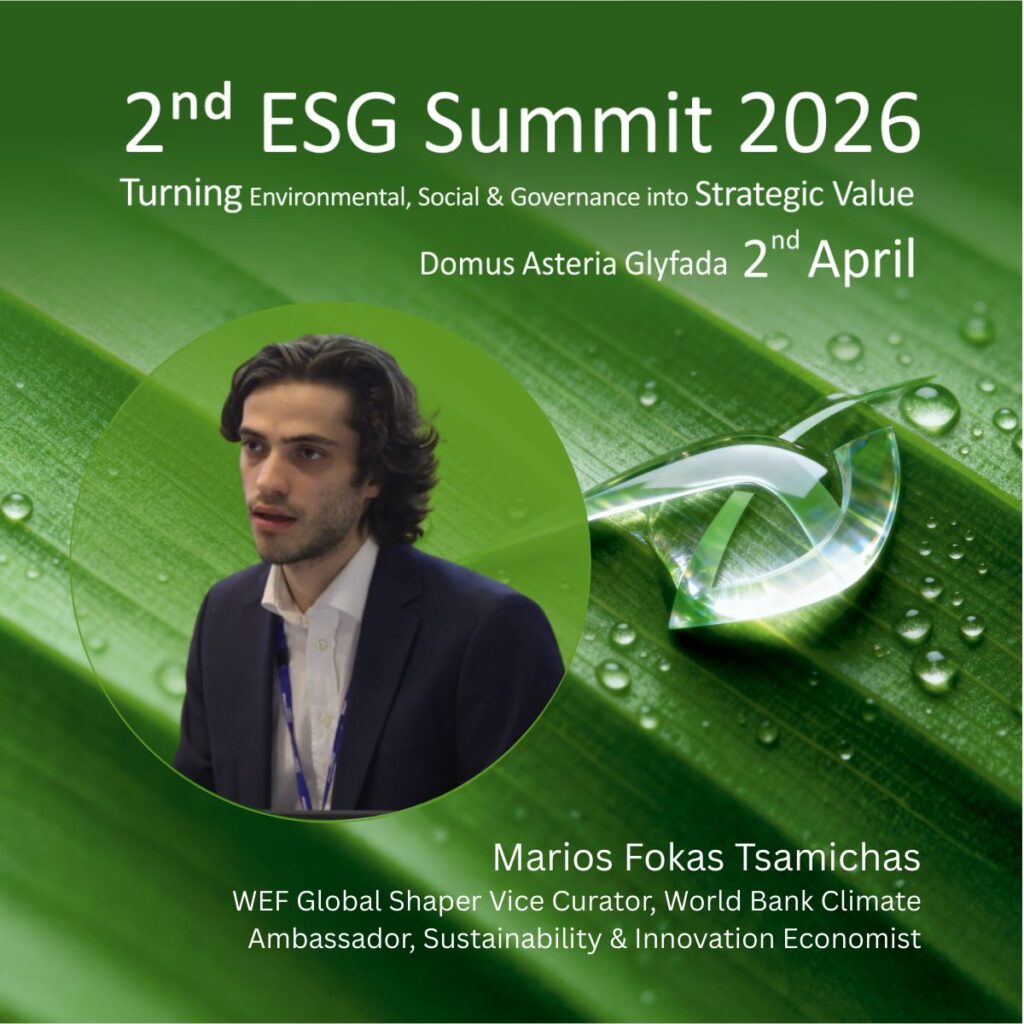
Energon Green Solutions is proud to announce that our Founder, Marios Fokas, will participate in the 2nd ESG Summit 2026 as moderator of the panel discussion “Cultivating Change: How ESG Transforms Food Sustainability.”

The Summit, organized by ICAP CRIF, will take place on April 2, 2026, at Domus Asteria in Glyfada, Athens, bringing together business leaders, policymakers, innovators, and sustainability experts to explore how Environmental, Social, and Governance (ESG) frameworks are shaping the future of business strategy and economic development.

Advancing the ESG Dialogue

The ESG Summit 2026, titled “Turning Environmental, Social & Governance into Strategic Value,” aims to move beyond compliance-driven sustainability and focus on ESG as a driver of long-term economic value, resilience, and responsible growth. Through expert discussions and sector-focused panels, the event will explore the evolving European regulatory landscape, investor expectations, and practical approaches companies can adopt to integrate ESG principles into their operations.

For businesses across Europe and globally, ESG is no longer an optional framework. It has become a strategic pillar influencing capital allocation, corporate governance, environmental stewardship, and social responsibility.

“Cultivating Change”: ESG and the Future of Food Systems

One of the Summit’s central discussions will focus on food sustainability, a topic increasingly critical as climate change, supply chain pressures, and global population growth reshape agricultural systems worldwide.

The panel will feature distinguished speakers:
Eirini (Rineta) Mitsi, Corporate Affairs & Sustainability Director, Goody’s – Everest Group
• Konstadia Stavrakopoulou, Quality Assurance Manager, ASTERIA Glyfada

Moderated by Marios Fokas, the panel titled “Cultivating Change: How ESG Transforms Food Sustainability” will examine how ESG principles are transforming the food sector across multiple dimensions:

  • Sustainable agricultural practices that reduce environmental impact
  • Transparent and traceable supply chains that strengthen consumer trust
  • Climate-smart production models that enhance resilience in farming systems
  • Responsible corporate governance in agri-food businesses
  • Technological innovation supporting sustainable food production

The discussion will highlight how integrating ESG frameworks into food systems can create more resilient agricultural economies, improve environmental outcomes, and strengthen global food security.

Leadership in Sustainability and Innovation

Marios Fokas represents a new generation of global sustainability leaders working at the intersection of climate policy, innovation, and economic transformation.

He currently serves as:

  • Vice Curator of the Global Shapers Community of the World Economic Forum
  • Climate Ambassador for the World Bank
  • Sustainability & Innovation Economist

Through his work across international institutions, research initiatives, and sustainability programs, Marios contributes to projects that promote climate resilience, responsible technological innovation, and inclusive economic development.

His role as moderator at the ESG Summit reflects his broader commitment to bridging global sustainability policy with practical business solutions.

The Role of ESG in a Transforming Economy

As regulatory frameworks evolve and investors increasingly prioritize sustainability metrics, companies are facing a new strategic reality: ESG integration is becoming essential for competitiveness and long-term value creation.

The Summit will explore several key themes shaping this transformation:

  • The EU’s rapidly evolving ESG regulatory environment
  • Investor expectations regarding sustainability performance
  • Sector pathways toward clean energy, biodiversity protection, and sustainable resource management
  • The growing role of technology and AI in ESG monitoring and reporting
  • The importance of strong governance and corporate transparency

For organizations navigating this landscape, events like the ESG Summit provide valuable opportunities to exchange knowledge, identify best practices, and build partnerships that accelerate sustainable innovation.

Energon Green Solutions: Supporting the Sustainability Transition

At Energon Green Solutions, sustainability is not simply a concept—it is the foundation of our mission. Our work focuses on developing innovative solutions that support the transition toward cleaner energy systems, responsible resource management, and sustainable economic growth.

The participation of our founder at ESG Summit 2026 reflects Energon’s commitment to actively contributing to the global sustainability dialogue and the development of forward-thinking ESG strategies.

As ESG frameworks continue to reshape industries—from energy and technology to agriculture and finance—collaboration between policymakers, businesses, and innovators will be essential to building resilient and sustainable systems for the future.

Looking Ahead

The ESG Summit 2026 promises to be one of the most important sustainability events in Greece this year, bringing together leading voices from across sectors to explore how ESG can drive meaningful change.

Energon Green Solutions looks forward to contributing to these conversations and supporting initiatives that promote sustainable innovation, responsible governance, and long-term environmental stewardship.

We are proud to share that our Founder, Tsamichas Spyros-Nikitas, contributed three analytical articles to the YES Europe Future of Energy Report 2025 a landmark interdisciplinary publication shaping the conversation on Europe’s energy transition for policymakers, investors, and industry stakeholders.Published by Young Leaders in Energy and Sustainability (YES) Europe, the report brings together researchers from across the continent to examine the legal, technological, geopolitical, and financial forces reshaping how Europe produces, distributes, and governs its energy.

Our contributions sit at the intersection of EU energy law, digital innovation, and sustainable finance precisely the domains where Energon Green Solutions operates. The report reflects our firm conviction: that Europe’s energy transition is not merely a technical or environmental challenge, but a deeply legal, institutional, and financial one. The rules we write today on governance, on digital infrastructure, on capital markets will determine whether the transition is just, resilient, and durable.

Our Three Contributions

1. Energy Communities and EU Law: Unlocking Local Power through GovernanceThis article analyses the EU Clean Energy Package provisions establishing Renewable Energy Communities and Citizen Energy Communities, mapping the governance models available to these entities and the regulatory barriers that continue to limit their uptake. We examine how ambiguous transposition across Member States creates uneven playing fields and argue that local energy governance is not peripheral to the energy transition, it is central to its democratic legitimacy.

2. From Blockchain to Energy Tokens: Can Digital Innovation Really Reshape the Energy Market?We critically examine the promise and limits of blockchain-based energy solutions, from tokenization of renewable assets and peer-to-peer trading platforms to smart contract automation in grid management. The article evaluates the regulatory implications for EU energy market rules, including REMIT and the Electricity Directive, and asks whether existing legal frameworks are equipped to govern decentralised digital energy infrastructure or whether structural reform is overdue.

3. Green Finance or Greenwashing? The Real Story Behind ESG, Carbon Credits & Climate CapitalThis article offers a critical evaluation of EU sustainable finance architecture: the Taxonomy Regulation, SFDR, CSRD, and the voluntary and compliance carbon markets. We assess the integrity of climate-aligned capital flows, identify structural vulnerabilities that enable greenwashing, and evaluate whether the EU’s disclosure regime is sufficient to redirect private capital toward credible decarbonisation pathways or whether stronger enforcement mechanisms are required.

Why This Research Matters

Europe’s energy ambitions are often discussed in terms of megawatts, megatons, and billions of euros. But the actual success of the transition depends on governance architecture: who has the right to produce energy, under what conditions capital is labelled “green”, and how digital platforms can operate within a regulatory environment designed for a different era. These are legal and institutional questions, and they demand rigorous legal analysis.At Energon Green Solutions, we believe that siloed approaches to the energy transition produce incomplete analysis and poor policy outcomes. The YES Europe report exemplifies the interdisciplinary methodology we champion, grounding technological and financial analysis in EU law, and ensuring that legal commentary is informed by real market and innovation dynamics.

Read the full Future of Energy Report 2025 here:

https://yeseurope.org/wp-content/uploads/2026/03/Future-of-Energy-Report-2025.pdf